




Short answer: a day is survivable, two days is dangerous, three is often fatal. Those thresholds assume a healthy adult cat in a cool house, and every one of them shortens with age, illness or heat.
Start the clock from the last drink you actually witnessed, not from when the bowl last looked full. Evaporation and a second cat both flatter the numbers.
Dehydration starts fast.
Below is the cat dehydration rundown, hour by hour.
After that, five at-home checks and the triage your veterinarian uses daily.
What Dehydration Does to Your Cat's Body, Hour by Hour

Cats came from desert ancestors. That means your kitty's kidneys concentrate urine harder than yours, pulling fluid back from waste so cats need less water than most other pets. That biology buys you time.
But that biology won't buy you 96 hours.
0-12 Hours
In the first 12 hours, you won't see much. Those kidneys work harder, producing the famously concentrated urine VCA Animal Hospitals describes.
Underneath that, blood pressure stays steady. Your cat is still alert, and the bowl gets ignored even as drinking habits visibly drop.
13-24 Hours
By 13 to 24 hours in, gums start to feel slightly tacky instead of slick. A skin tent on the back of the neck still snaps back fast.
A careful cat parent spots reduced water intake plus slightly less elastic skin around the mouth. Hydration is already slipping.
25-48 Hours
Between 24 and 48h, clinical dehydration arrives. Sunken eyes show up alongside real lethargy and lower urine output. Kidney function is now under measurable strain.
Cornell Feline Health Center treats this stage as a same-day veterinary call.
49-72 Hours
From 48 to 72h things get dangerous, with electrolyte imbalances and a climbing heart rate.
Vomiting at this stage turns a slow deficit into a fast one, because fluid is now leaving from both ends of the equation. It is also the point where topping up at home stops being realistic.
Over 72 Hours
Past 72h is genuinely life-threatening. Sunken eyes, weak posture and continued lethargy point to organ damage already underway, and a cat here needs an emergency vet.
Compress the whole timeline for kittens, senior cats and any cat with kidney disease, diabetes or hyperthyroidism. These cats have far less reserve, so treat a call-tomorrow sign as a call-today.
A kitty with vomiting or diarrhoea can hit clinical dehydration in as little as 12h. Those windows compress further when running water is absent and your cat is left only with a stale water bowl.
What that timeline shows is that each hour without water costs more than the one before it.
Every figure above is a ceiling for a healthy cat, not a target for yours. If your cat is elderly, unwell or a kitten, work from the tier tables below instead.
Where a Stainless Steel Fountain Fits as an Always-On Solution
Everything above is triage. What stops you ever needing it is duller by comparison: water your cat will drink without being persuaded, available at 4am as readily as at teatime.
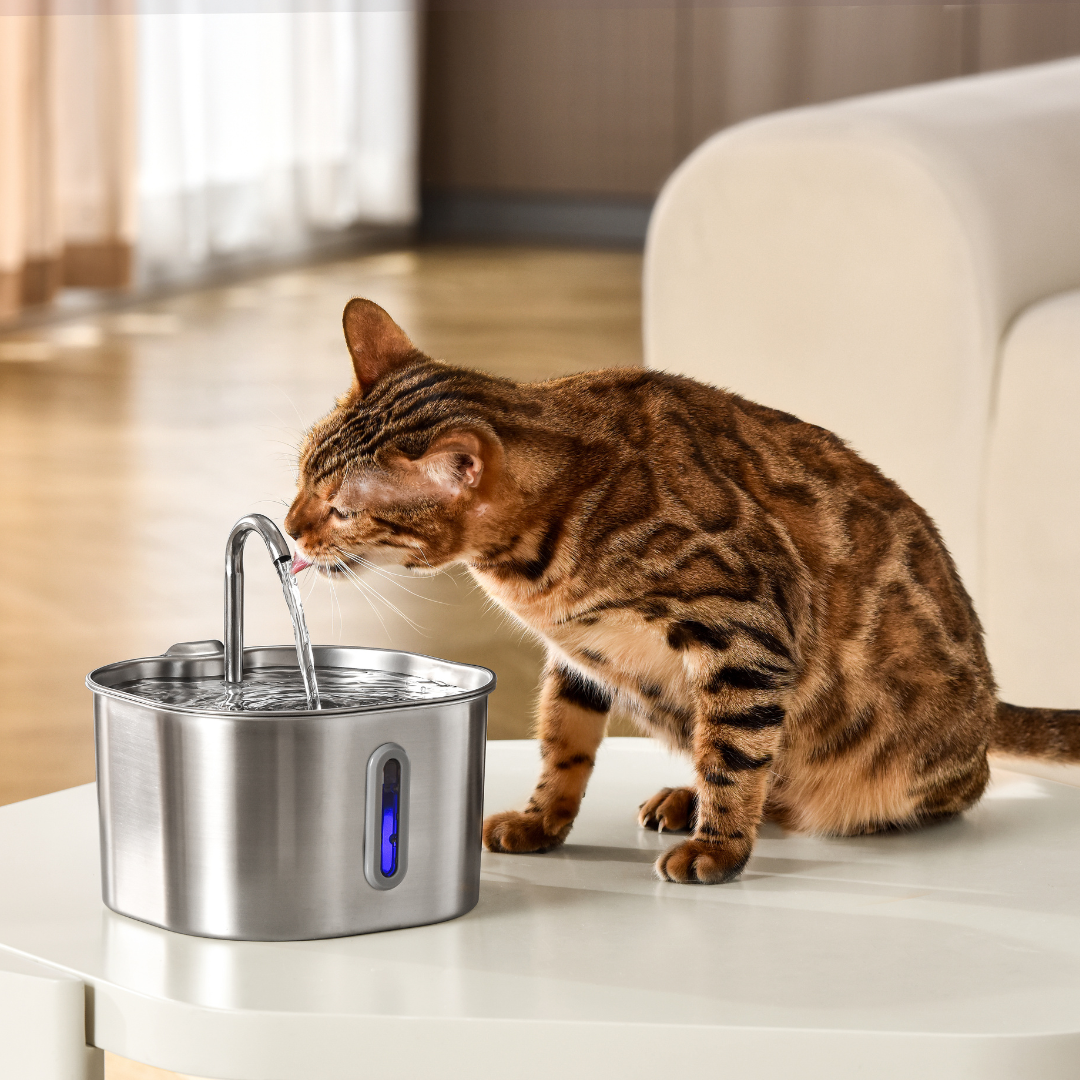
The KittySpout Wireless Fountain 2.0 fixes those reasons in one device.

Fill it, wash it weekly, and water stays available whether or not anyone is home to notice the bowl is empty.
Stainless steel and a 3-layer carbon filter clean up the taste of the water, removing chlorine and heavy metals on KittySpout's published figures. Plastic bowls put some cats off for a different reason: they scratch, and a scratched bowl holds odours and film that steel doesn't.
Good water intake supports cats with kidney disease and is one of the standard recommendations for cats prone to lower urinary tract problems. It doesn't improve kidney function, and it isn't a treatment, but it takes one stressor off a system already under pressure.
Fill it once and the device handles the rest of the fortnight.
Try the KittySpout Wireless Fountain 2.0 here
The Skin Tent and Gum Test for Spotting Dehydration in 30 Seconds
You don't need a vet to spot a dehydrated cat early. The signs of dehydration in cats split into five quick checks, all under a minute.
Two abnormal results mean moderate fluid loss.
-
Skin tent. Pinch the loose skin behind the shoulder blades and let go. A 1 to 2 second delay flags moderate dehydration.
-
Gum check. Press a fingertip on the gum above an upper canine and hold for one second. Pink, moist, slick gums with colour returning within two seconds is what you want. Tacky or dry gums point to dehydration; a refill slower than two seconds is about circulation rather than hydration alone, and it is the more worrying of the two.
-
Look at the eyes from above and from the side. Hollow or deeply set eyes signal moderate fluid loss in the body.
-
Paw pads and ear tips. Rest a hand on the paw pads and ear edges. Cold paws and ears in an unwell cat are a late sign, not an early one, and they suggest circulation is failing. A cat with cold extremities and any of the other findings above needs an emergency vet now.
-
Watch for a hunched posture or slow blinks. A reluctance to jump fits the same picture, and a weak walk or unusual sleeping spot completes it.
Two abnormal results means your cat has moved to moderate dehydration. The KittySpout article on how to tell if your cat is dehydrated covers the same checks in depth.
Here's what your veterinarian wants you to do next.
When to Wait, When to Call, and When to Drive to ER
Knowing the timeline is half the answer. Knowing what to do at each stage is the other half. The three tiers below follow the way most practices triage a dehydrated cat over the phone, and your cat sits on one of them right now.
Wait and watch is the first dehydration tier.
Cat alert and eating, pink moist mouth tissue, snap-back under one second. Offer wet food or low-sodium broth and a fresh water source away from the food bowl.
A cat that is eating, alert, and drank sometime yesterday sits here. Offer wet food or a little low-sodium broth and keep watching.
Call your veterinarian today is the second tier.
Your cat is quieter than usual, the gums feel slightly sticky rather than slick, and pinched skin takes a second or two to flatten back down.
No water intake for 24 to 48h fits the same stage of escalation.
Ring your usual practice for a same-day slot. Fluids under the skin often form part of it, but the vet will want to know why drinking stopped, so expect bloods or a urine sample alongside.
Drive to the emergency vet is the third tier.
It applies when your cat is collapsed or unable to stand. Dry or pale gums and a skin tent over 2 seconds belong here.
Repeated vomiting belongs here. So does 48 hours or more without water, and any of these signs in a kitten or senior cat, which goes straight to emergency without a call first.
IV fluids, blood work and an overnight stay are the standard response.
Those three tiers carry one override: existing illness halves the threshold. A cat already diagnosed with CKD, or a senior sitting at the call-vet markers, becomes an emergency case instead.
That group decompensates fast, and kidney function is usually why, which is what makes a same-day appointment rarely soon enough.
Why Your Cat Stopped Drinking, and How to Restart Them

The six reasons cats stop drinking come next. Five of them have a fix you can apply this afternoon.
Most have a fix you can run today.
-
Dirty bowl or stale water. Rinse the bowl twice daily and top it up with clean water both times.
-
Keep the bowl a metre or two from the food and well away from the tray.
-
Some cats will not put their face into a narrow, deep vessel at all. A wide shallow bowl, or a fountain with an open dish, removes the objection.
-
Objections aside, diet is the next factor. A kibble-only cat has to make the entire daily requirement up at the bowl, where a canned-fed cat starts most of the way there, and one wet meal a day closes a surprising amount of that gap.
-
Offer multiple water locations after a recent stress event, illness or house move. Lukewarm fluid in fresh bowls smells stronger to your cat.
-
Underlying illness. Dental pain and nausea cut water intake, while kidney disease, diabetes and hyperthyroidism usually push it up. A change in either direction is worth a vet visit, and it is the direction of the change that helps them narrow it down.
The published figure is about 50 ml per kg of body weight over 24 hours, food included.
Heavily chlorinated tap water puts some cats off entirely, and they drink normally once it is filtered. A carbon filter removes that variable.
The KittySpout Wireless Fountain 2.0 covers four of those six triggers through fresh water, running water and a whisker-friendly bowl.
For an older cat the aim is fewer dry spells rather than a bigger daily total. Intake spread across the day is what keeps urine dilute, and that is the part associated with fewer flare-ups.
That's the full picture on how long can a cat go without water, by the hour. Find what keeps your cat hydrated. A cat fountain is usually the simplest answer.